Earlier this year, while organizing boxes in the basement, I came across a file filled with some of my father’s personal papers from the 1970s and ’80s. Many were written in his distinctive, almost Gothic script, shaped by eight years of studying Greek.
Alongside essays about education in America were several fascinating reflections, offering his perspective on topics ranging from the life of Frederic Bastiat, my parents’ adventures with a Guatemalan patriot, and a Cold War essay about Russian cabbage.
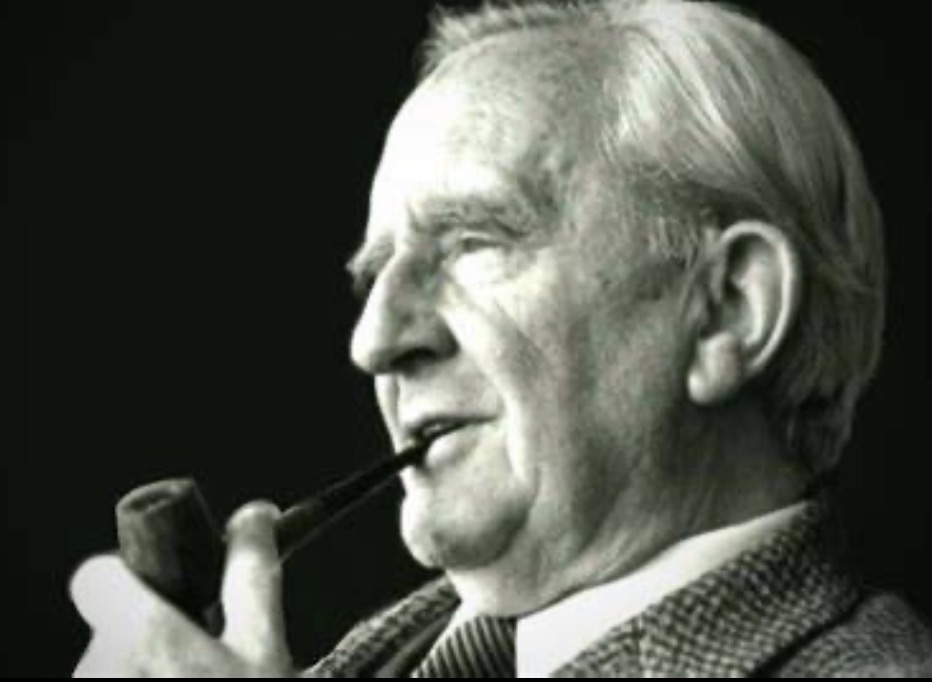
The piece that caught my attention, however, was an insightful reflection on the life of J.R.R. Tolkien, written shortly after his death in 1973:
“Frodo and Friends”
This past summer saw the death of an authentic literary hero. J.R.R. Tolkien died in his 81st year. In an age when “realism” in literature has been so overemphasized that its votaries become steadily more fantastical in their attempted portrayal of a twisted “reality,” Tolkien remained an uncompromising romantic.
Tolkien also remained a highly private man. Throughout his long career as a philologist and university professor, he avoided public attention like the plague. Yet the glare of international popularity pursued him for the last twenty years of his life, all because of a piece of imaginative writing originally intended as a family project. Shortly before the 2nd World War, Tolkien wrote a story for his children-a romance peopled by various characters, some traceable to classical themes, some the direct product of the author’s amazing imaginative powers. Publication of The Hobbit in 1938 was the first step in Tolkien’s creation of an entire imaginary world, Middle-earth. Over the next fifteen years, Middle-earth continued to take shape, culminating in the three volumes comprising The Lord of the Rings.
When The Lord of the Rings reached the public in the mid-fifties, Tolkien found himself the center of a veritable cult. A generation of American college youth took Middle-earth for its own. Most of those young people perhaps never realized that they were reading a great Christian parable. What they did recognize was the unmistakable sense of wonder and zest which comes with the rediscovery of integrity, courage, honor, fellowship, and all those other qualities which are pre-requisites for both good literature and the good life.
In a world where power has replaced truth and a sordid “realism” has replaced the old-fashioned virtues, Tolkien’s work is a helpful antidote. The only really valid criticism of The Lord of the Rings was expressed by the author himself-the book should have been longer.
Description or summary of such a work is simply impossible. For those who have never read The Lord of the Rings, a supreme pleasure awaits. On behalf of those who have read and who periodically re-read that magnificent testimony to the human soul, hail and farewell to a blithe spirit. Frodo’s creator may be gone, but he and his work are far from forgotten.


